
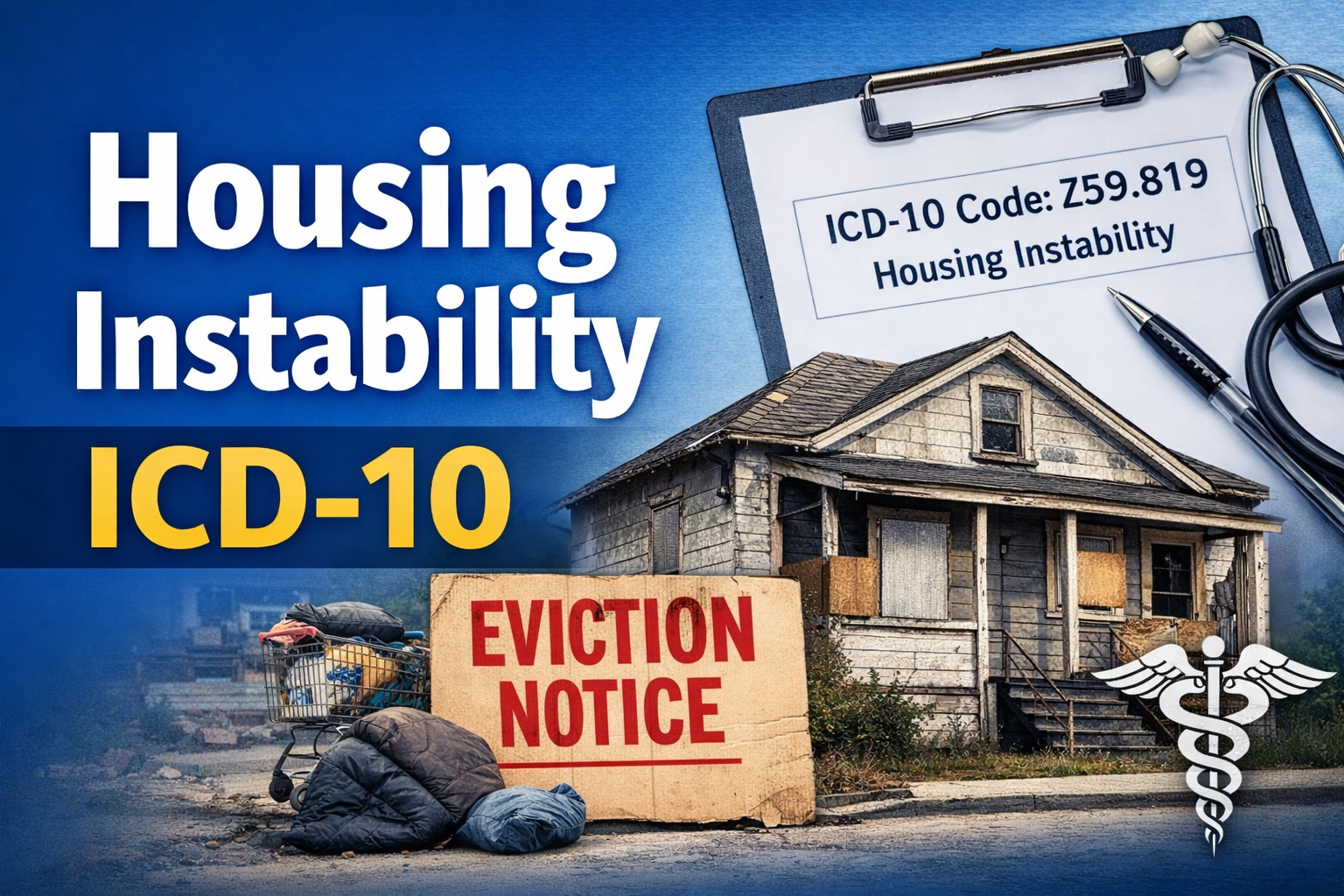
How to Code for Housing Instability in ICD‑10: A Powerful Guide (2026 Update)
Introduction: Housing Instability in ICD‑10
How to Code for Housing Instability in ICD‑10 is a crucial skill for healthcare providers, coders, and administrators. Housing instability is recognized as a social determinant of health (SDOH) that directly impacts patient outcomes. The ICD‑10‑CM provides specific codes to capture these circumstances, ensuring accurate documentation and reimbursement.

Focus Keyword Definition & Importance
The Focus Keyword: “How to Code for Housing Instability in ICD‑10” reflects both the technical coding process and the broader healthcare context. Using this keyword strategically improves search visibility while educating professionals on coding accuracy.
ICD‑10 Code Z59.819 Explained
- Code: Z59.819
- Descriptor: Housing instability, housed unspecified
- Category: Problems related to housing and economic circumstances (Z59)
- Billable: Yes, effective October 1, 2025
- Excludes2 Notes:
- Extreme poverty (Z59.5)
- Financial insecurity (Z59.86‑)
- Low income (Z59.6)
- Material hardship (Z59.87)
Documentation Requirements
To use Z59.819, providers must document:
- Patient’s current housing status (temporary, unstable, unsafe).
- Evidence of frequent moves, eviction risk, or shelter use.
- Impact on health outcomes (stress, missed appointments, poor medication adherence).
Clinical Scenarios & Examples
Examples of when to use Z59.819:
- Case 1: Patient living in a shelter → Code Z59.819.
- Case 2: Patient facing eviction but still housed → Code Z59.819.
- Case 3: Patient homeless → Use Z59.00 (Homelessness, unspecified).
Coding Guidelines & Excludes Notes
Best practices include:
- Always pair Z codes with clinical diagnoses when applicable.
- Use Excludes2 notes to avoid misclassification.
- Example: A patient with low income (Z59.6) and housing instability (Z59.819) can be coded with both.
Common Mistakes to Avoid
- Using Z59.819 for homelessness (should use Z59.00).
- Missing documentation of housing status.
- Ignoring Excludes2 notes.
Linking ICD‑10 with Social Determinants of Health
Housing instability coding supports:
- Population health management
- Risk adjustment models
- Policy advocacy for affordable housing
External Resources & References
For more details, visit:
See also our ICD‑10 Coding Basics Guide and SDOH Documentation Checklist.
Conclusion
How to Code for Housing Instability in ICD‑10 is more than a technical task—it’s a way to capture the lived realities of patients and improve healthcare outcomes. By using Z59.819 correctly, coders and providers contribute to better data, stronger advocacy, and more equitable healthcare.
When documenting social determinants of health (SDOH) like housing instability or homelessness, it is highly critical to look at the broader clinical picture. In US healthcare systems, environmental stressors rarely exist in a vacuum, and capturing them accurately directly impacts risk adjustment models. For example, stable housing plays a massive role in medication adherence and treatment compliance for patients managing severe psychiatric conditions. When navigating these complex charts, capturing the external environment is just as vital as utilizing the correct ICD 10 Code for Paranoid Schizophrenia.
The exact same compliance and documentation standards apply in public health and rehabilitation clinics, where structural vulnerabilities frequently disrupt recovery pathways. Because of this, US payers heavily emphasize tracking housing factors alongside substance use disorders to map out comprehensive patient care. If you are auditing charts in these settings, you will often need to pair your SDOH codes with specific dependency guidelines, as outlined in our Definitive Guide to Opioid Use Disorder ICD 10 Code.
Beyond behavioral health, prolonged exposure to unstable living environments or lack of hygiene resources frequently leads to secondary physical issues that require independent clinical management. Patients experiencing homelessness are statistically at a much higher risk for chronic, untreated dermatological complaints caused by environmental exposure. When a patient’s chart notes severe, chronic skin irritation heavily exacerbated by these harsh living conditions, make sure you are cross-referencing and billing the proper clinical criteria for the Prurigo Nodularis ICD 10 Code to ensure the complexity of the visit is fully documented.